Losing a tooth can affect more than the appearance of your smile. It may influence chewing, speech, and the way surrounding teeth meet. Choosing the right missing tooth replacement depends on factors such as the location of the gap, the condition of neighboring teeth, your oral health, and your preferences for comfort and maintenance. Two commonly considered solutions are a dental bridge and a partial denture. Understanding how they differ can make a consultation more productive and help you decide which approach may suit your needs.
Why Replacing a Lost Tooth Matters
A missing tooth can leave neighboring teeth with less support and may affect how pressure is distributed when you bite and chew. The empty space can also make cleaning more challenging, particularly when food repeatedly collects around the surrounding teeth.
Replacement is not always about appearance. Depending on the location of the missing tooth, restoring the space may help improve everyday function and maintain a more balanced bite.
The ideal solution varies from person to person. A dentist will generally consider the health of the gums, remaining teeth, jawbone, bite, and overall dental history before recommending an option.
Comparing the Main Options
When considering single missing tooth replacement options, patients often compare bridges and partial dentures because both can restore the visible gap without requiring an implant.
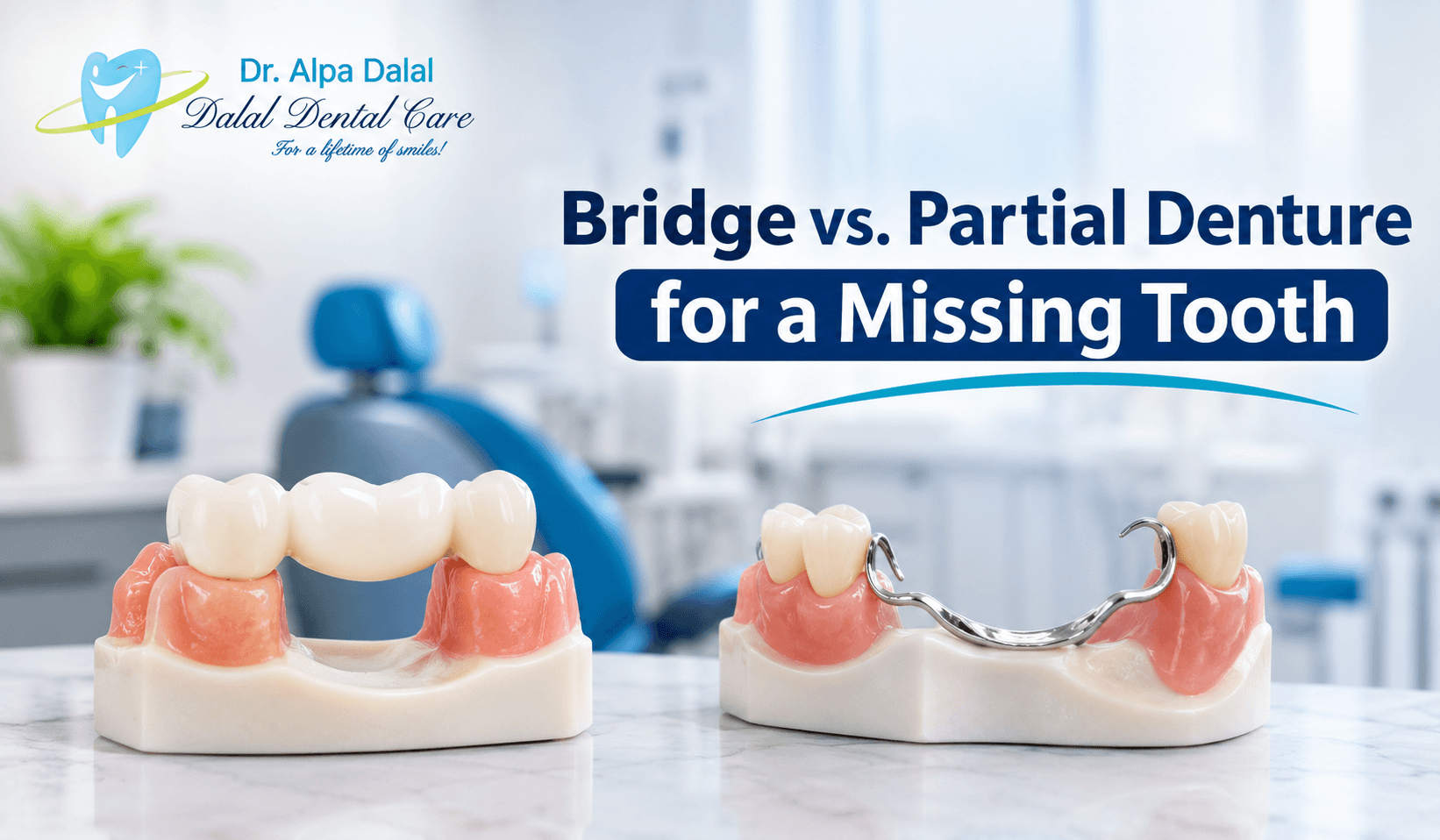
A bridge is a fixed restoration. It typically uses neighboring teeth as support for a replacement tooth, creating a restoration that remains in place during normal eating and speaking. A partial denture is removable and may replace one or several teeth using a framework, clasps, or other retention methods.
| Factor | Dental bridge | Partial denture |
| Stability | Fixed in place | Removable |
| Support | Usually relies on adjacent teeth | Uses remaining teeth and oral structures |
| Daily removal | Not normally required | Removed for cleaning and often at night |
| Treatment approach | More permanent-feeling | More flexible and adjustable |
| Multiple missing teeth | May require several restorations | Can often replace several teeth |
| Maintenance | Requires careful cleaning around the restoration | Requires regular cleaning outside the mouth |
Neither choice is automatically better. The right option depends on the condition of the mouth and what the patient prioritizes.
Comfort, Appearance, and Everyday Use
A bridge may feel more similar to a natural tooth because it is fixed and does not need to be removed during meals. However, keeping the area beneath and around the restoration clean requires appropriate brushing and specialized cleaning techniques.
A partial denture offers the advantage of being removable. This can make cleaning more straightforward and may provide a practical approach when several teeth need replacement. Some patients, however, need time to become comfortable with the appliance and may notice differences in speech or chewing initially.
Appearance is another consideration. Modern dental materials can be designed to blend with surrounding teeth, but the final result depends on the restoration type, materials, and individual circumstances.
What a Dental Evaluation Should Consider
Before choosing between these approaches, a dental examination is important. A best dentist in dublin ca can evaluate the teeth surrounding the gap and determine whether they are healthy enough to support a restoration.
The assessment may consider:
- The condition and position of neighboring teeth
- Gum health around the missing area
- The patient’s bite and chewing pattern
- The number of teeth requiring replacement
- Existing crowns, fillings, or other restorations
- Cleaning and maintenance preferences
- Budget and long-term treatment goals
In some cases, neither option may be the first recommendation. An implant-supported restoration could also be discussed when appropriate. The important point is to compare solutions based on the patient’s actual oral health rather than choosing solely by appearance or initial cost.
Caring for Your New Restoration
Whichever option is selected, good maintenance plays an important role in protecting the restoration and the remaining teeth. Brush consistently, clean between teeth, and follow the dental team’s instructions for cleaning around a bridge or removable appliance.
A partial denture should be cleaned regularly according to professional guidance and handled carefully when it is removed. Bridges require particular attention around the supporting teeth and underneath the replacement tooth.
Regular dental examinations can also help identify changes before they become significant. A restoration does not eliminate the need for ongoing oral care.
Conclusion
A bridge and a partial denture can both restore a missing tooth, but they differ significantly in stability, maintenance, treatment approach, and how they fit into daily life. A thorough dental evaluation is the best way to determine which solution matches your oral health and priorities. If you are considering replacement and want individualized guidance, consulting the best dentist in livermore can help you understand the available choices and make a decision based on long-term function, comfort, and oral health.
FAQs
Is a bridge more comfortable than a partial denture?
Many people appreciate the stability of a fixed bridge, but comfort varies. A partial denture may take some time to feel natural.
Can a partial denture replace only one tooth?
Yes. Depending on the patient’s oral anatomy and treatment needs, a partial denture can be designed to replace a single missing tooth.
Does getting a bridge require altering neighboring teeth?
Traditional bridges generally involve preparing supporting teeth. The extent of preparation depends on the specific design and clinical situation.
How long does either option last?
Longevity varies according to oral hygiene, bite forces, materials, maintenance, and overall dental health. Regular checkups can help extend the useful life of a restoration.
Can I eat normally with either option?
Most patients can eat comfortably after adapting to their restoration. Some foods may require extra care, particularly during the adjustment period.